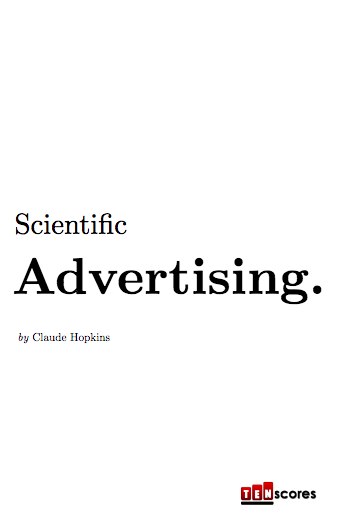
Written by Claude Hopkins, 1923
In the world of advertising, there are few books that stand the test of time. One such book is "Scientific Advertising" by Claude Hopkins. Published in 1923, this book has been a staple in the advertising industry for almost a century. It is a timeless masterpiece that highlights the importance of data-driven advertising and the power of testing. In this blog post, we will take a closer look at this book and explore its key takeaways.
One of the core principles of "Scientific Advertising" is the importance of testing. Hopkins believed that advertising should be treated as a science, and that every ad should be tested rigorously to determine its effectiveness. He emphasized the need to test different headlines, images, and messages to see what resonated with the target audience. According to Hopkins, the only way to know what works is to test it. He famously said, "Almost any question can be answered, cheaply, quickly and finally, by a test campaign. And that's the way to answer them – not by arguments around a table."
Another key principle of "Scientific Advertising" is the power of direct response. Hopkins believed that advertising should be designed to elicit an immediate response from the target audience. He advocated for the use of coupons, special offers, and other incentives to encourage people to take action. He also believed that every ad should have a clear and compelling call to action. According to Hopkins, the goal of advertising is not to entertain or inform, but to get people to take action.
Finally, Hopkins stressed the importance of salesmanship in advertising. He believed that advertising should be designed to sell products, not just create brand awareness. He emphasized the need for ads to focus on the benefits of the product, and to use persuasive language to convince people to buy. He also believed that advertising should be honest and transparent, and that companies should only make promises they can keep.
In conclusion, "Scientific Advertising" by Claude Hopkins is a must-read for anyone interested in advertising or marketing. Its principles are just as relevant today as they were almost a century ago. The book highlights the importance of testing, direct response, and salesmanship in advertising. It is a timeless masterpiece that should be on the bookshelf of every marketer.