By Christian N.
PDF Companion
Follow a fictional business as it applies every step of the process to boost LPE. Get PDF

There were two businesses.
In one, we had the freedom to change everything. Brand positioning, design, landing page copy, hero images. All of it was open to my heart’s desires… and expertise.
In the other, we could only make small text edits on the landing pages.
The result? For the first, Landing Page Experience (LPE) gradually improved. 80% of keywords hovered at Above Average across the account.
For the other? Everything was, and still is, Below Average.
Brand positioning matters, and I didn’t have permission to change it and experiment in one of the two. That limitation led to a stagnant 3% conversion rate, while the first business gradually climbed to 8% globally, with some pages hitting 12% to 15%.
Why am I talking about conversion rate when this is supposed to be about Landing Page Experience? Because for Google, it seems to be the same thing.
Let’s take a step back.
We’ve been led to believe Landing Page Experience (LPE) is about speed, bounce rate, or something in between. I tried believing that too… until I noticed a pattern.
Every time I improved my page speed score… nothing.
Focused on bounce rate? Still nothing.
But every time I got an “Above Average” LPE, it came after a big jump in conversion rate.
I shared the full breakdown in this article, but here’s the short version:
LPE = CVR
What follows is the exact process I’ve used to improve LPE, and how I’ve taught it to our team over the last few years.
1. Unity
Change Your Mindset
It’s one connected experience.

You must switch your thinking from looking at your landing pages as individual elements of your advertising.
They cannot be evaluated separately from the ads that bring people to them, nor the search terms that initiate the journey.
A search term, an ad and its landing page are one single entity.
Example.
You’re booking a flight.
You search “cheap flights to Wakanda.”
First result: “50% Off Flights to Wakanda”.
You click. The page loads. No mention of “50% off”.
You close the tab. Gone with the wind.
That’s the problem.
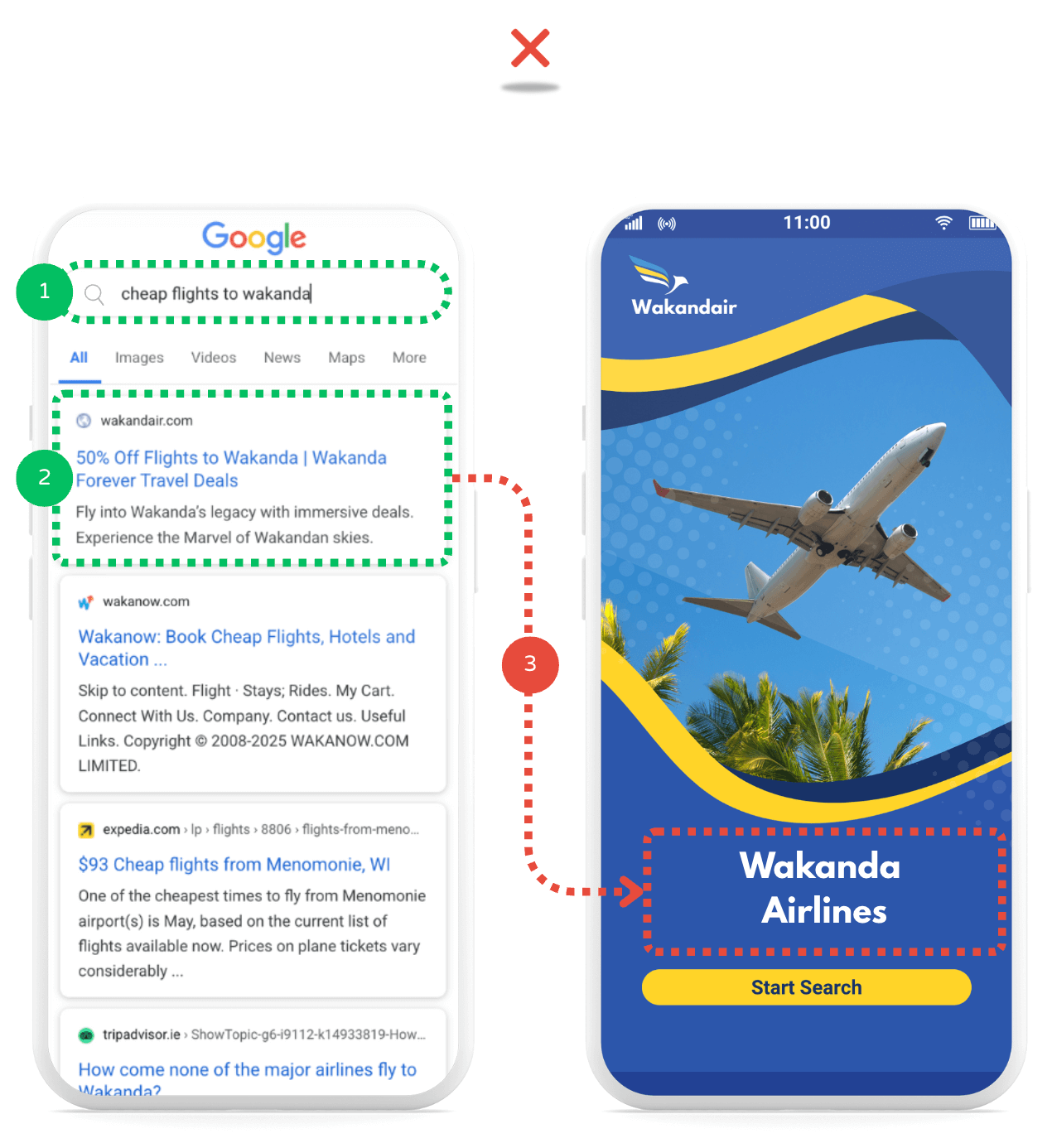
The most basic of solutions would have kept you around just a little bit longer. Maybe, just a few seconds more that would have led you to a conversion.
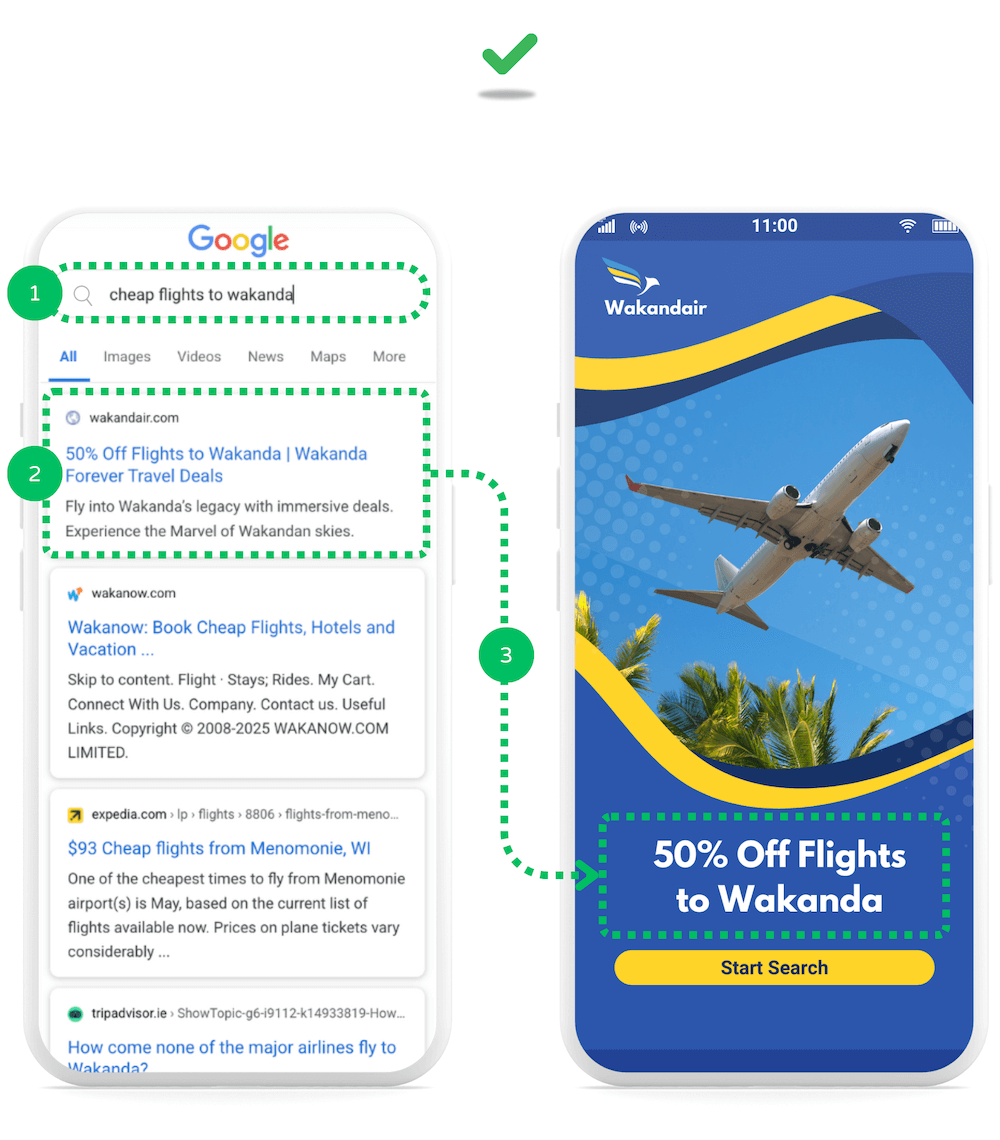

Ditch the old mindset
It might seem obvious, but it’s easy to forget.
Small business owners who have other things to do besides managing their Google Ads accounts are prone to this.
I know because I talk to them all the time.
They see keywords, ads, and landing pages as separate things and they ask me how to optimize each in isolation from the others.
Google doesn’t see them as isolated.
Users don’t.
Advertisers shouldn’t either.

See things anew
Your new mindset is to treat them each as one side of the same object, of which no side can be disassembled and manipulated individually.
A search is a question.
The ad is an answer.
The landing page is proof.
If one part breaks, trust is lost, and in a split second, so is the conversion.
When people land but don’t convert, it’s not just the page. It’s the whole experience.
Every mismatch creates friction. Every bit of friction lowers interest.
So first, adopt and remember the new mindset.
Keywords, ads, and landing pages aren’t separate, they are one connected experience. They are inseparable from each other, where one cannot be analyzed without the others.
This is easy to forget.
Once you drown your eyes into metrics and data, spreadsheets, tables and charts, you will forget how a user’s experience starts and how it ends.
How a user’s experience starts is how it ends. What they first see influences how they behave.
2. The Enemy
Know The Traps
Google is not your friend.

Google measures the full journey:
Search Term → Ad → Landing Page → Conversion
But understanding Google’s approach is not enough.
You must also understand that Google is not your friend.
In this quest, you’ll encounter obstacles that will make it harder for you to deliver a unified user experience from start to finish. It’s a game, with hidden rules.

Dirty match types…
… require constant cleaning.
Problem: Match types aren’t what they used to be. Google now shows your ads to people whose search terms may barely relate to your keywords.
Solution: Watch your search terms like a hawk. Create new ad groups for relevant search terms you discover, so you can tailor the experience. And add negatives for anything that doesn’t belong. The goal: Keep your ad, landing page, and search term perfectly aligned.
.

Obscure RSAs…
… hide what matters most.
Problem: With Responsive Search Ads, Google won’t tell you which headlines are doing the heavy lifting. You’re left guessing which ones show up, and whether they match your landing page.
It’s easy to lose the thread.
Easy to break the experience.
And Google doesn’t care.
Solution: You have to dig. Open up asset performance. Find out what headlines actually show.
Then ask: do these match the landing page? Do they match the search term? Because if they don’t… your user won’t stick around to figure it out.
Your message should stay consistent,
from the search term to the ad…
to the page.

Alien locations …
… aren’t science fiction. They’re Google’s default.
Problem: You think you’re targeting people in Vancouver. Google thinks: “Cool, let’s show your ad to someone in Kansas who once Googled Vancouver.”
Unless you change the setting, your ad goes interstellar.
I forget this all the time, and I’ve paid for it.
Solution: In campaign settings, location options, switch from “People in, or interested in” to “People in or regularly in your target location”. Otherwise, you’re spending money on Earthlings you never meant to reach. Go and check right now, you might find an unpleasant surprise.
3. The Target
Set A Goal
It’s double CVR, then double again.
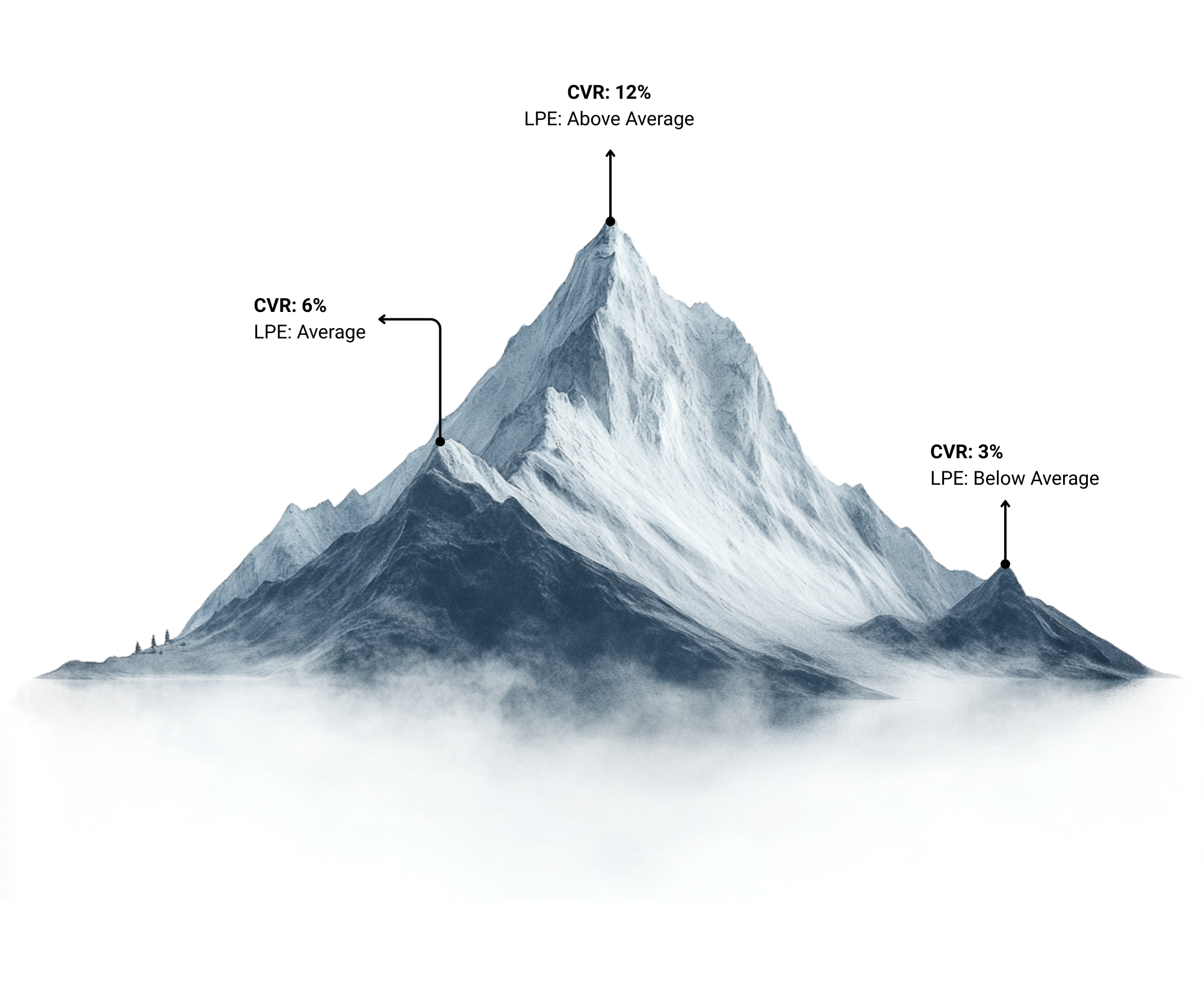
This isn’t guesswork anymore.
The lower your CVR, the lower your LPE.
Simple.

Use the rule of doubles
Wherever you are, double your conversion rate to move to next level.
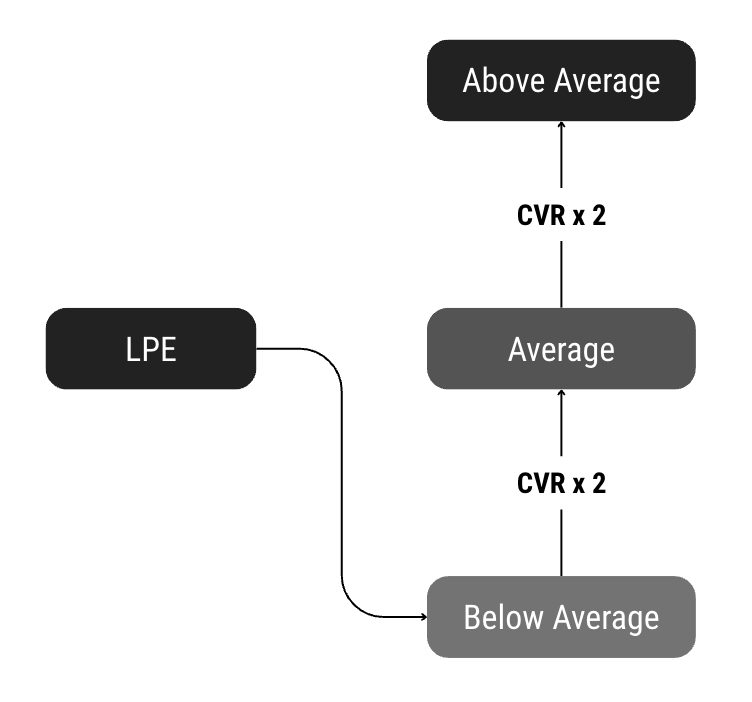
Is it exact? No.
But it’s close enough to move in the right direction.
And reach the peak earlier than you thought.

Is that not too high?
That depends on your market.
Others are converting higher than you are.
That’s what LPE is telling you.
It’s showing you what’s possible.

Find the exact number
Calculate what a double CVR is for you, then…
Push toward it.
This is your lever.
Without it, you’re just making random changes and hoping something sticks.

What it means
A double CVR shows itself very quickly.
You don’t have to wait long to know if your changes will have long lasting impact.
And on that journey, small increases are keepers too.
4. Introspection
Look Into The Mirror
Reflect on your own journey.
This is where you walk the path yourself.
Search, click, land, decide.
Would you convert?
If not, why?

1. Walk your own path
Search the way a user would. Click your own ad. Go through the journey.
| ✅ Do this | ❌ Not this |
|---|---|
| Search for your keywords like a user | Assume your users behave like you hope |
| Click your own ad and explore the page like it’s your first time | Skip steps or use internal links |
| Fill out the form or try the checkout process | Only test the homepage |

2. Look for friction
Notice anything that slows you down, feels confusing, or breaks trust.
| ✅ Do this | ❌ Not this |
|---|---|
| Ask: “What would make me hesitate here?” | Assume users will “figure it out” |
| Simplify steps wherever possible | Add unnecessary fields or instructions |
| Remove distractions from the page | Overload with too many offers |

3. Does it feel trustworthy?
Would a stranger feel safe giving you their info or money?
| ✅ Do this | ❌ Don’t do this |
|---|---|
| Add trust signals (reviews, guarantees, badges)* | Assume trust comes from design alone |
| Use clear, transparent language | Use vague or overhyped claims |
| Make it clear who you are and what happens next | Hide behind generic messaging |
* Note: The wrong trust signals can hurt conversions. Test first before adopting any.

4. Use real data
Use tools like Amplitude, Hotjar or Clarity to see what people actually do.
| ✅ Do this | ❌ Don’t do this |
|---|---|
| Watch session replays to find drop-off points | Rely only on gut feeling |
| Use heatmaps to check scroll depth and clicks | Assume users read everything |
| Fix the spots where people get stuck | Ignore patterns in behavior |

5. Check mobile first
Google prioritizes mobile for LPE. So should you.
| ✅ Do this | ❌ Don’t do this |
|---|---|
| Test your full journey on a phone | Only check desktop |
| Use autofill, click-to-call, chat buttons | Force long forms |
| Check layout, tap targets and CVR | Ignore mobile conversion rate |
Making the conversion path on mobile is important. Let people convert where they naturally spend time, whether it’s WhatsApp, Messenger, or any platform prevalent in your country.

6. Test multiple intents
Not all search terms mean the same thing. Test different queries and see if the experience still makes sense.
| ✅ Do this | ❌ Don’t do this |
|---|---|
| Search your keywords and look at the intent behind them | Treat all keywords as the same |
| Make sure the landing page matches that intent | Send everyone to the same generic page |
| Adjust content and CTAs if needed | Assume one-size-fits-all |

7. Treat it like a mystery
CVR is low for a reason. Find it.
| ✅ Do this | ❌ Don’t do this |
|---|---|
| Be honest about what’s not working | Assume everything is fine |
| Test with real users if possible | Only rely on your team’s feedback |
| Keep digging until something clicks | Give up after one test |

Key Takeaway: Don’t guess why users aren’t converting. Walk their journey, fix the friction, and let the data show you where to act.
5. Positioning
(re)Position Your Brand
You’re judged by who you are.
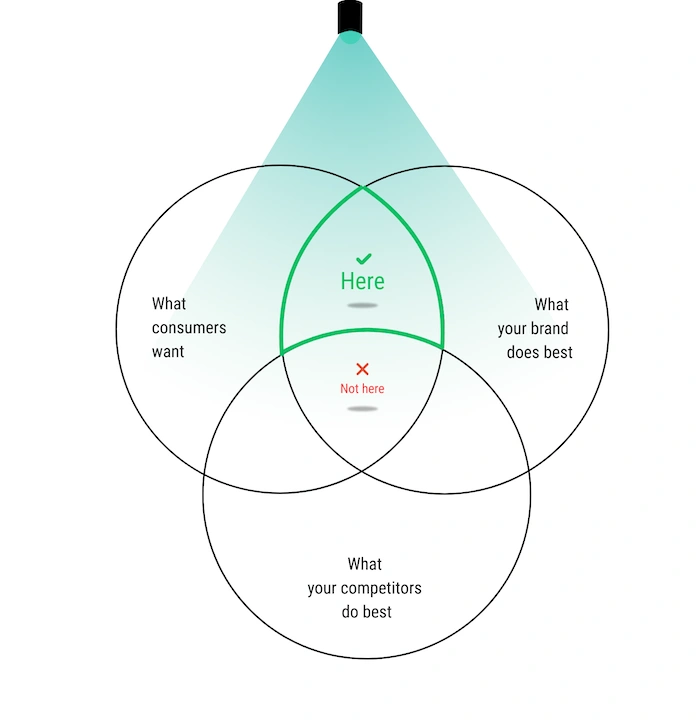
It’s not just your landing page.
Users don’t land in a vacuum.
They came from a list of choices. You were one of many.
They’ll visit others.
And they won’t stick to just your landing page, they’ll look around your website, your company, your brand and judge if you’re worth the try.
You only have seconds to make it clear why you’re different.
If they don’t get it fast, they’re gone.
Think carefully about what makes your brand unique.
Then highlight it repeatedly.

Check the landscape
To reposition your brand, first look around.
Start with reviews. Your competitors’, and your own.
You don’t have to read it all, use AI to summarize.
What do people love about them?
What do they hate about them?
What keeps coming up over and over?
Who do they serve best? Who can you serve better?
That’s where the gold is.
Bad service. Confusing process. Hidden fees. Poor communication. If customers complain about it, you can own the opposite.
If some specific customer segment is poorly served, you can own that space.
Then look at your own reviews.
What do people say you do better?
That’s your edge.
That’s the start of your positioning.
You don’t need to invent a story.
Just amplify what already works.

Change your offer
Good positioning means nothing if your offer is weak.
Make it easy for them to get a foot in the door. No obstacles.
Stack your offer next to competitors.
Who gives more value?
Who gives more confidence?
Who is easier to try?
It doesn’t have to be cheaper.
It has to feel better.
If their offer beats yours, start there.
Everything else, copy, design, layout … comes after.

Positioning = clarity + difference
It’s not about looking good.
What’s your unique angle? What’s your edge?
Generic promises don’t work.
“Trusted experts.” “Best prices.” “We care.” Everyone says that.
Say something only you can say.
Remember: you’re not alone on the search results.
The user is comparing.
They’re checking tabs, looking for signals.
You have one shot to stick.
A strong position makes you memorable.
It makes them stop searching and start trusting.

Yes, stronger brands convert better
When your positioning is clear and unique, people feel it.
Clear positioning builds trust. Fast.
It makes people stop searching.
It makes them believe.
That’s how you win the click.
That’s how you win the conversion.
And that’s how you win at the Above Average LPE game.
Key Takeaway: Make it obvious what makes you different, before users hit the back button.
6. The Ads
Find The Alpha
One ad to rule them all.

Everything before this point?
It was training.
This is the first real fight.
The Alpha Ad is the one that leads.
Not just better… dominant.

What’s an Alpha Ad?
It’s the ad that rises above the rest.
Higher CTR.
Better clicks.
Stronger conversions.
You’ll know you’ve found it when Exp. CTR goes Above Average
and keeps climbing.
That’s your signal.
That’s your Alpha.

Start with the ad, not the page
Most advertisers begin with the landing page.
That’s backwards.
Start with the ad.
The ad defines the offer.
The offer defines everything else.
You’re not optimizing yet.
You’re hunting for the ad that changes everything.

Use AI
We’ve already made this easier.
We’ve trained a custom Ad Copywriter GPT to write ads the right way, using empathy, not guesses.
It follows the same methods we explain here.
Use it.
Follow the prompts.
Find your Alpha faster.
Most ads will fail.
That’s the point.
You’re not looking for average.
You’re looking for the one ad that leads the pack.
You’re not looking for average.
You’re looking for one that breaks the pattern.

The offer
AI can write the words,
but you decide what’s worth writing about.
Think of your offer like a cube.
Each side is a new angle.
Example:
Keyword = “improve quality score”
Offer 1 = Quality Score Tool (Free Trial Software)
Ad Angles =
- Ad Test 1: Highlight all the features
- Ad Test 2: Highlight all the benefits
- Ad Test 3: Showcase user results
- Ad Test 4: Mix all the above
Offer 2 = Quality Score Cheat Sheet (Free PDF Download)
Ad Angles =
- Ad Test 1: Highlight where the info comes from
- Ad Test 2: Showcase your results
- Ad Test 3: Highlight how easy the process is
- Ad Test 4: Mix all the above
Every offer is a different kind of candy for the Searcher. A cube.
A cube has multiple sides.
Each side becomes a different ad.
Same offer. New lens.
It’s important to test multiple cubes, on the same search need.
Different offers. Different angles.
Try offering information instead of selling the product.
Try offering a guided demo instead of a trial.
Try offering a comparison of all products in the market place.
If one offer leads…
That’s your Alpha.

What to do when you find it?
Re-align your landing page to match it.
Same language. Same promise. Same emotional pull.
This is where basic realignment starts to matter.
Because now you have something worth aligning to.
And this is how you get Above Average Landing Page Experience.
Key Takeaway: Great ads start with strong offers. Find multiple cubes. Show each one from every side.
7. The LP
Dance With The Searcher
Mirror their mind. Match their pace.

Your brand positioning is on point.
You’ve found the Alpha Ad.
Now it’s time to dance.
There’s a melody when someone searches.
Their minds aren’t blank. They have words. Feelings. Expectations.
Your job is to match their rhythm.
Not step on their toes.

Tighten the fold
Focus on the very first things they see when they land.
The top section must sell the scroll.
If you’re doing this:
A generic headline, random stock image, and a vague button.
Test this instead:
A clear headline that matches your ad, a relevant image that supports the offer, and a strong call-to-action that invites rather than begs or try to convince.

Match their words
If your ad repeats their search terms, they click.
If your landing page repeats them again, they stay.
That’s message match.
That’s joining their dance.
Ad mirrors search.
Page mirrors ad.
No gaps. No surprises.

Dynamic headlines are your dance shoes
One page.
Endless steps.
Use UTM parameters or landing page tools to shift:
- Headlines
- Subheads
- Hero images
You’re not building a page.
You’re building a mirror.
When they see themselves in your words, they move forward.
When they don’t, they vanish.

It doesn’t have to be perfect
But it has to feel like you heard them.
If the ad says “Free Visa Assessment,” the landing page shouldn’t say “Start Your Immigration Journey.” It should say: “Get Your Free Visa Assessment.” (This is a real mistake I made recently, and how I fixed it.)
Same words. Same promise. The user feels: “Yes, this is exactly what I asked for.”

Simple moves to keep the flow alive
Match the promise in the CTA.
Don’t dump everyone onto the same boring page.
Adjust content for how ready they are.
Use small steps first.
Mirror their emotions: urgency, hope, fear, excitement.

Don’t force the dance
Don’t make them fill out 10 fields.
Don’t demand what they aren’t ready to give.
Don’t push. Invite.
The best dancers don’t drag their partners. They guide.
If you move like they move,
they’ll move toward you.
8. Divinity
Please The Gods
The algorithms are always watching.

You’ve done well, fellow traveler.
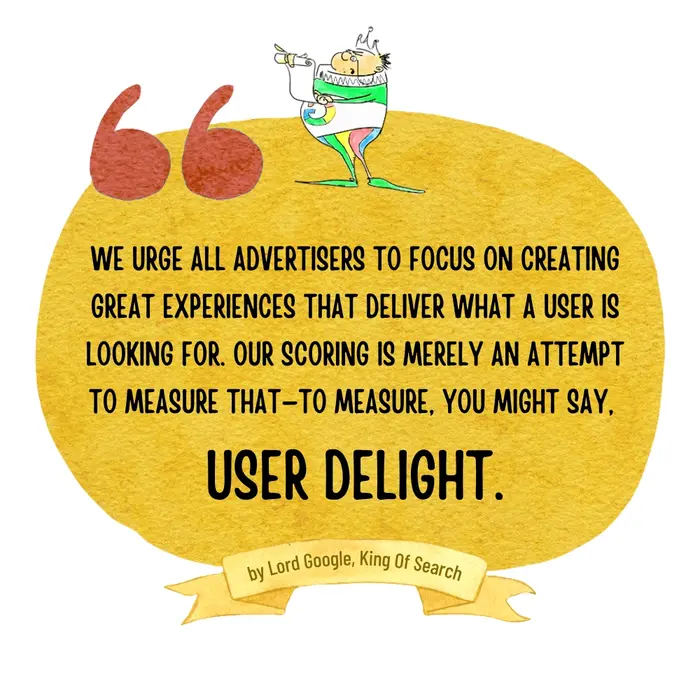
Now you know everything Lord Google demands.
Your pages are aligned. Your ads are strong. You are… worthy.
The gods of conversions may soon reward you with higher CVR, better LPE, and fewer tears.
The blessings of Saint Quality Score herself are with you.
As for me, my fate is uncertain.
I have more gods to please.
They’re cruel, chaotic gods.
The gods of social.
- Engagor, the Thirsty. Feeds only on likes.
- Scrollon, Lord of Thumb Pauses. Punishes content that doesn’t stop the feed.
- Retwita, the Algo Queen. Opens her gates only to those deemed shareworthy.
If I don’t please them, I’ll be cast into the Shadow Realm of Zero Reach, where even good content dies alone.
I’ve been there before,
it’s no fun.
Actually, I’m still there.
It’s no fun.
It silences even the most charismatic voices. (I’m referring to the “Charisma” article that I never wrote.)
So if this helped you,
Please offer a tribute:
Retweet the tweet below.
Google says your Landing Page Experience is “Below Average.” You panic. You fix speed. You fix bounce. Nothing happens. I went down the same road.
— Chris N. (@chrisnziza) May 26, 2025
Here’s what actually matters (and what Google won’t admit): 🧵 pic.twitter.com/sijvstHaB5
Did this allow you to revisit an old concept? Did you learn anything new? Is there something I missed? I’m waiting for you in the comment section to continue the conversation.