By Christian N.
Imagine you own a store.
It’s beautiful. Clean. Well-organized.
Every product is perfectly placed.
You make sure every customer has a great experience.
You care.
They walk in, smile, browse.
Some buy, some don’t. But no one complains.
No one leaves frustrated.
Everything feels right.
Then, one day, it’s the store reviewer.
He walks around, takes notes, says nothing. Then he leaves.
A week later, his review is published.
“Below Average Customer Experience.”
What? How?
People loved your store. No one ever said otherwise.
You check the details.
No mention of messy aisles.
No complaints about service.
No issues with checkout.
So what went wrong?
That’s exactly how it feels when you start chasing Google Ads Landing Page Experience.
You follow the rules.
Fix what they said matters.
Yet the score stays low.
It took me years to figure it out.
And when I did, everything changed.
It used be simple. An on or off switch.
It was either great or bad, and you knew what was wrong, knew what to fix, no guessing.
Then it slowly morphed into something more complex.
Not a binary lever anymore, but a scale.
A mysterious scale.
One full of speculation.

They said it’s page speed.
In 2018, I got this message from a someone who works at Google:

He was referencing our Quality Score page, in which we detail what it takes to improve Quality Score, and in which we described speed to be “rarely an issue”.
And it rarely is. I’ve tested, and tested again.
Stripped my pages of all scripts, get a 99 page speed score.
Didn’t work.
Kept images to a minimum, and only in .webp format.
Didn’t work.
Even tried AMP pages.
Didn’t work.
Doing a quick google search on Landing Page Experience shows generic articles all mentioning page speed, almost always as the top factor to improve.
Couldn’t be further from the truth.
In my messy unscientific research, I analyzed 10 landing pages from different businesses in separate markets that only had one thing in common: Landing Page Experience scores Above Average.
Did they have a great page speed score?
Nope.
They had a wide range of speed scores on mobile and desktop.
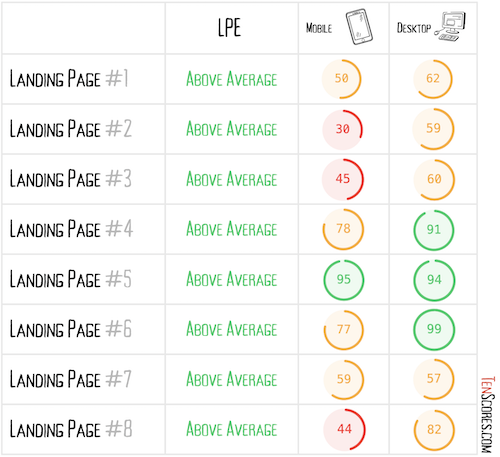
So this wasn’t it.
Is page speed important?
Of course it is. It’s a baseline. A default. Shouldn’t even be talked about.
Most websites are just good enough, our competitors websites are probably just good enough and we’re not going to compete with them on page speed.
It’s like telling a professional marathon runner that he needs great shoes.
It can surely help, but won’t be the reason he wins or looses the race.

They said it’s bounce rate.
Or something similar.
Maybe bounce back rate, pogo sticking, dwell time… something in that nature.
For a long time, I was convinced that this was the key.
It just made sense.
If a user bounces or doesn’t stick around long enough, surely that’s a sign of poor service.
So I set out to conduct my own “experiments”, in quotes because once again they were messy, nothing scientific.
Breaking a page into multiple shorter pages linked together, to build depth and reduce bounces.
Didn’t work.
Providing as much information as possible on the page, with useful content in hopes they will consume it, stay longer and want to click around.
Didn’t work.
None of those will likely move the needle if you’re solely focusing on them individually. They’re a side-effect, not the root cause of poor Landing Page Experience.
Finding the root cause will have the effect of lowering bounce rate, bounce back rate and everything in between.

So then, what is it?
Customers come to me asking:
Chris, I’ve been trying to improve my LPE by optimizing my landing page. I’ve added keyword-rich content, it’s relevant, speed is great, but LPE is still below average, what am I doing wrong?
And I’ve said to them:
The problem isn’t speed. It isn’t page content. It’s your conversion rate.
I’ve been saying this to customers for about 2 years now.
Without taking a look at their landing page, without looking their google ads account, I know for a fact, if your Landing Page Experience score is “Below Average”, your conversion rate —is— below average.
I should have written about this for you a very long time ago.
My apologies.
This may not be news to some, as I’ve read a few people talk about it on Youtube and reddit. So for the sake of adding my own voice to the confirmation, and for you who follows us, I’m writing this here so that you don’t have to wonder any more.

LPE = CVR
Yes, your Landing Page Experience is directly proportional to your conversion rate.
That’s half the formula.
The rest of the formula is that your conversion rate is compared to other advertisers who are competing against you, with the better score going to the better CVR and the lower score going to the lower CVR.
And so just like we’ve understood for a long time that Expected Click-Through-Rate works exactly like that, now so does LPE in conjunction with CVR as the driving force.
Google closed the loop on user experience evaluation.
They had been trying to measure user experience from start to finish for a long time. Looks like they now did, and have for a while.
The main reason that I haven’t shared it before, is that I don’t have definitive proof.
And most importantly, until recently, I was wondering how Google could know the conversion rate of a website? Let alone compare it with other websites.
Through Google Analytics?
Maybe, but not all website use it, and many haven’t set it up to track conversions. Even if they did, how would Google know they were tracking the right conversions?
Through the Google Ads tag?
Maybe, but just like GA, not all website use it, and many haven’t set it up to track conversions. And even if they did, how would Google know they were tracking the right conversions?
The answer came to me when I read Rand Fishkin’s article on leaked Google API documents last year. It showed that Google uses Chrome browser’s data to know all websites’ analytics.
And that’s how it all come together:
- Google has access to Chrome data for virtually any website. With over 65% of the browser market share, Chrome is widely used, giving Google all the data they need for user engagement on any website.
- They don’t need any kind of analytics scripts. Whether you’re using Google Analytics or the Google tag or any other tracking script, is irrelevant. They don’t need it, Chrome provides.
- They can compare data for sites competing against each other. Users on Chrome will navigate your site, then your competitors’ site. Google tracks where the conversion happened, rewarding the advertiser who converted, and punishing the one who didn’t.
I asked Rand what he thought about the idea that Google had access to and could be using direct conversion data, here’s what he said:


Can you prove it?
That they use Chrome data?
No, I can’t. They’ve been trying to hide this, and it got leaked.
That conversion rate is the metric?
No, I can’t.
But I can show you something…
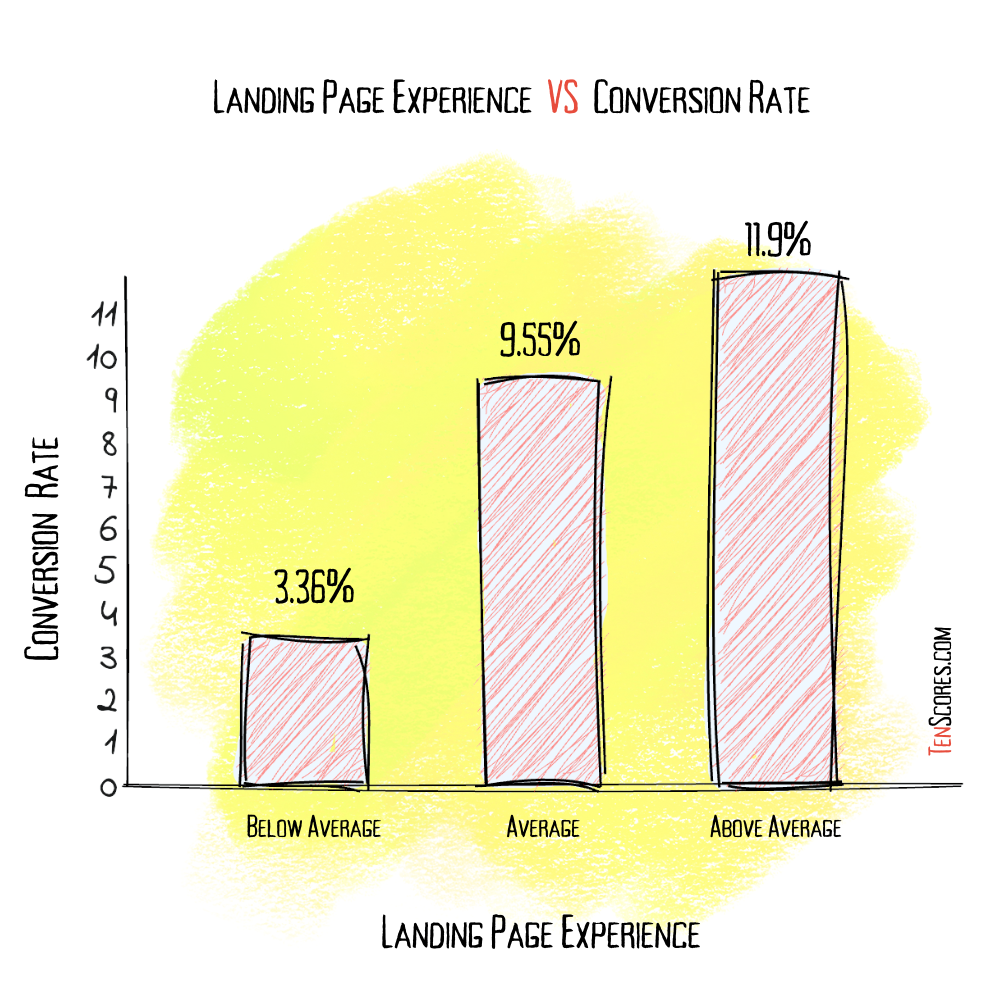
Does that prove anything?
No, it doesn’t.
It’s just one account.
The biggest piece of information I can provide that could convince you that this is so, comes from the horse’s mouth.
Google hinted at this 10 years ago in a document titled “Settling the (Quality)Score” which stated:
Try using conversion rate as a proxy for good landing page experience. We don’t use it in our calculation of landing page quality, but it can be a good proxy for you to measure and optimize against. It’s also something that should matter a whole lot to your bottom line, so you’re probably keeping a close watch on this already.
Settling The (Quality) Score (Read it on page 8)
When I first read that, it sounded like an interesting point.
But then I went back to “how could Google know what my conversion rate is?” and I believed what they said about “we don’t use it in our calculation”. That was enough for me to dismiss the CVR note, and go back to equating LPE to something closer to bounce back rate, which made the most sense at the time, knowing that Google would easily have data on it: people simply returning to the search results page, which they own.
The way I should have understood is:
Conversion rate —is— the proxy for good landing page experience. We compare yours with other advertisers and decide whether it is ‘Average,’ ‘Below Average,’ or ‘Above Average’.
And it makes perfect sense.
It’s the last step of the searcher’s journey.
After the click, they found what they were searching for.
Isn’t that Google’s whole reason to be?

Are you sure?
I’m not sure of the specifics.
Google probably does use a combination of engagement signals that culminate into lower or higher conversation rates.
In fact, what would make sense is to use Conversion Rates in combination with other engagement metrics to define whether the conversion led to satisfaction or not. User delight, or user disappointment. It’s most likely much deeper that we will ever know.
It’s a measurement of “user delight”, as I’ve heard Hal Varian (inventor of Quality Score) describe it.
Trying to uncover the exact formula isn’t meaningful to me.
What matters to me is information that leads to results.
And for the last few years, the only way I’ve been able to make progress on LPE is by making gains on CVR.
Here’s an example:
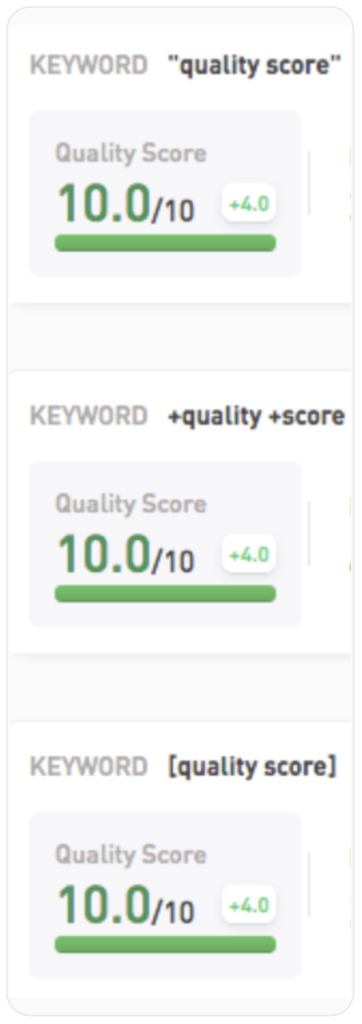
This happened many years ago, we still had Modified Broad Match (Rest In Peace), I was doing a lot of landing page testing and my conversion rate rose significantly overnight. Didn’t take long for the last piece of the puzzle to fall in line. I’d been struggling with it almost forever.
If like me, results is what you’re looking for, then focus on what you can act on that produces visible outcomes.
Focus on CVR.
Whether I’m right or wrong, there can only be good outcomes from a strong focus on conversion rates.

What does it mean?
It means that Landing Page Experience is now a competitive intelligence tool, a metric that shines some light on how your conversion rates stack up against past and present competitors for a specific keyword.
It lets you know whether there is opportunity for you to convert users at a higher rate.
This is invaluable information.
Used correctly, it helps you chart of path for growth for your business.
You don’t have to wonder whether there’s room for a better CVR, it’s right there for you to know.

Closing the loop.
First, it was click-through-rate. When an advertiser got more clicks than the next for the same amount of impressions, they got rewarded for writing the appealing ad.
Now, it is conversion rate. When an advertiser gets more conversions than the next for the same amount of clicks, they get rewarded for having the appealing offer.
I’ve read this in one form or another:
A good Landing Page Experience leads to a high Conversion Rate.
It’s the other way round:
A high Conversion Rate leads to a good Landing Page Experience .

So then, how do I increase CVR?
In the next post, we’ll get deeper into the specifics of boosting Conversion Rates with Landing Page Experience in mind. Here’s a preview:
- Dynamic Headlines (Message Matching). Your landing pages (or home page—I know you’re doing it 😩) should match your ads closely. You’re constantly testing new ad angles, as you should and I’m sure you are, but creating a new landing page each time isn’t scalable. The solution: Dynamic Headlines—headlines that change automatically based on the clicked ad, ensuring a seamless experience from search term → ad → landing page. This concept can be extended to the rest of the content on the page, with the right tools.
- Mobile Conversions. Google seems to prioritize mobile conversion rates heavily, so your mobile CVR needs to be exceptional. For lead generation, traditional forms aren’t as effective as letting users easily contact you via messaging apps like WhatsApp or Messenger. Sometimes, a simple chat widget does the trick. For eCommerce, you’re unfortunately on your own—I have no clue here (not my expertise 😅 … yet).
- CRO Concepts & Persuasive Copywriting. We’ll revisit or deepen your understanding of fundamental Conversion Rate Optimization (CRO) principles—such as strategically positioning your content above and below the fold. You’ll need persuasive copy to clearly communicate your business value and occupy a preferential spot in your prospects’ minds.
This will be an introduction to Customer Experience Optimization (CXO)—clearing the path, and turning Landing Page Experience into a competitive advantage rather than a frustrating mystery.
No more inexperience.